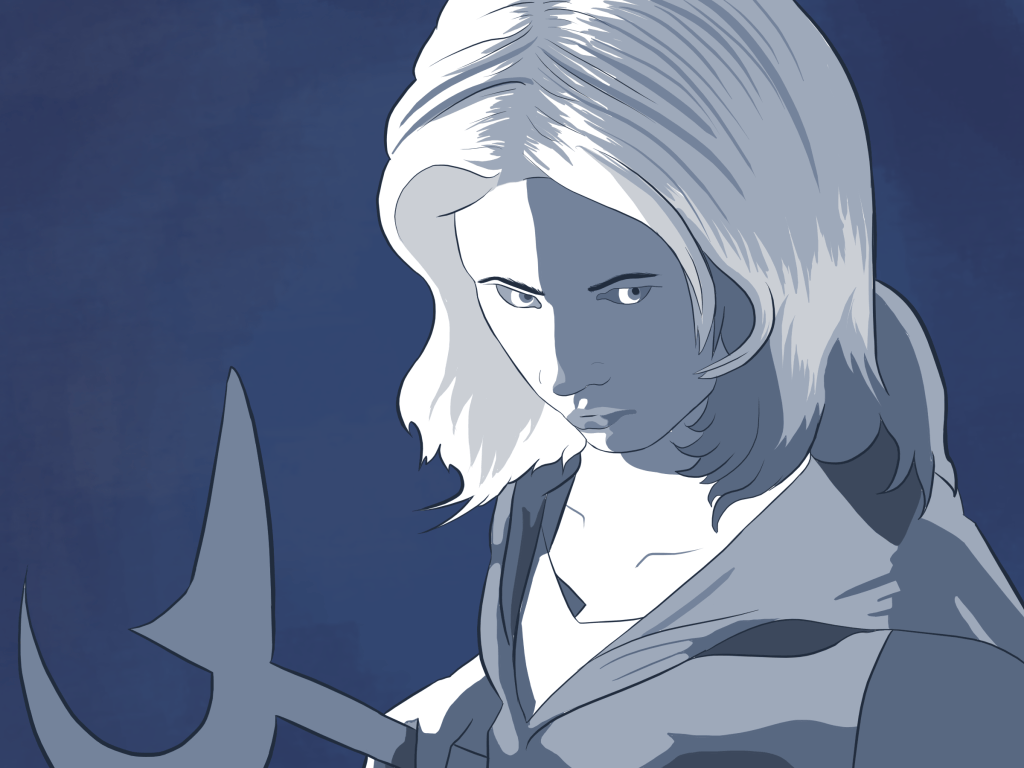
(The following is an essay I wrote for a Trans Studies course with Professor Stephanie Clare at the University of Washington. Ironically, I have since come out as gender fluid).
At the formative age of eleven, I binge-watched all of Buffy the Vampire Slayer (BtVS). I was obsessed with superheroes and the supernatural, which drew me to the show, but I remember thinking Buffy’s desire to be a normal girl made no sense. Buffy was so powerful and badass fulfilling her destiny by slaying vampires and monsters—and she did it in a dress. She was my ideal: feminine and strong. I did not understand why she felt unfeminine when she clearly looked feminine to me. Fast forward a few years to my teenagerhood. On a rewatch the episode “Never Kill a Boy on the First Date,” I saw myself in Buffy as she danced with her extremely boring date, Owen, and smiled, saying “I almost feel like a girl.” In the years since my first viewing of the show, I had developed a much greater understanding of the social world. I started public school. I created social media accounts. I also started dating. These experiences made me hyperaware of my body and the outside gazes upon it.
At sixteen, femininity was something I aspired to have but struggled to obtain due to the (perceived) differences between my body and the bodies of those labeled as feminine. Femininity was something I had to negotiate and practice. I still practice it, like a religion. I believe in it. But it never feels entirely mine, despite that I was assigned female at birth and no one has ever questioned my pronouns or gender. Everyone has always used the correct language. Like Buffy, it didn’t matter if everyone saw me as a girl, I ultimately couldn’t see myself as fully a girl. Now this is the part of the conversation where you, my dear friend, look at me with your eyebrows raised and say, “that doesn’t sound very cis of you.” Sometimes my friends say, “I forget you’re cis,” or they use they/them pronouns for me, or they say “you think about gender a lot more than most cis people,” implying that there’s something inherently trans about contemplating gender. This essay offers an explanation: I am Buffy.
Buffy is not trans, and she is not meant to be read as such. In the film which came before the show, Kristy Swanson’s Buffy can sense vampires through period cramps (yikes, Joss Whedon). While I am eternally grateful that this didn’t make it into the show’s canon, this connection between the female body and Buffy’s role as the slayer persists into the show. In season three episode “Faith, Hope & Trick,” Faith, another slayer, asks Buffy if slaying also makes her “hungry and horny,” tying slaying with female sexuality. Buffy’s slayer powers are all about her body—her petite, white, female body. In universe of the show (the “Buffyverse”), there is always supposed to be only one slayer in the world (although the show finds ways of introducing other slayers), and the slayer is always a girl. As was the norm in the 90’s, the show conflates biological sex with gender. While much has been said about the role of gender in BtVS in women’s studies and gender studies, trans perspectives offer something different. By poking at Buffy’s gender and seeing common experiences between hers and those of trans women, I want to point toward a way of identifying oneself that is both affirming and cognizant of political implications.
Identifying Buffy as not trans requires some definitional work. What does it mean to be trans? What does it mean to be not trans? Is it the same as being cis? In Transfeminist Perspectives in and beyond Transgender and Gender Studies, A. Finn Enke seeks to trouble the distinction between cis and trans, which brings forth several problems. Enke remarks that “if cis is equated—and it usually is—with gender normativity, in what ways does its achievement depend on class status, ability, whiteness, and the maintenance of racist and nationalist hierarchies?” (62). Buffy, for example, is generally situated as middle-class except perhaps in season 6, and she is certainly able-bodied, white, and American. Her ability to seek a “normal life” is much different from, say, Kendra, a Black Jamaican slayer. Kendra’s only personality trait is that she is a rule-follower. She eagerly follows the patriarchal system of the “watchers’ council,” a group of mostly men who track and guide slayers. Buffy is positioned as more radical than Kendra because of Buffy’s insistence on going to school, having friends, and dating alongside performing her slayer duties. What the show fails to explore, however, is how Kendra’s marginalized identities restrict her ability to seek normativity. Does this mean that she is less “cis” than Buffy?
Perhaps the problem is with the term “cis” itself. Enke admits that while “the concept of cisgender privilege provides a necessary critique of structural hierarchies built around binary sex/gender” (69), the category of “cis” requires us to continually define (and confine) what it means to be trans. They write that “such phrases as ‘as a gender-queer cis-woman I . . .’ or ‘the cis-man in the film said . . .’ don’t so much acknowledge as reinforce this privilege by enacting a distinction between cis and trans. Such speech invokes trans by its absence; and this absence is predicated on a definition of trans as a rare but visible embodiment of ‘cross-sex’ identification, or as the most institutionally recognized form of sex-crossing” (69). Enke doesn’t come out and say it, but they imply here that “cis” doesn’t really exist, although cis privilege does. I would agree, and I think it would be useful to refer to this privilege differently. Perhaps gender normative privilege would work better? It implies that there are ways of expressing and identifying gender that are more normative than others, and that those ways are more privileged. To believe in “cis” categorizes Buffy’s gender identity and experience alongside Kendra’s, her lesbian witch friend Willow’s, and the popular mean girl Cordelia’s. Each of these characters have very different levels of gender normative privilege despite all being “cis.”
Identifying the experiences that Buffy shares with (some) trans women reinforces the argument that cis is not a useful category. I stated earlier that Buffy is not trans—she is not cis, either. Buffy inhabits a girlhood/womanhood in question. She has some gender normative privilege, but it is also precarious. I argue that Buffy’s struggle grappling with this precarity reveals how our place on the gender normativity spectrum is not a given, and that between individual choices and social changes, our place can move. Additionally, for Buffy to remain on the more normative side of the spectrum, she must perform femininity. She expresses a desire to perform femininity, but where does this desire come from? Would she desire it if it did not afford her privileges?
Before answering these questions, I will establish how Buffy’s experiences align with transfeminine experiences. Buffy is first and foremost masculinized through her role as the slayer because of the slayer’s physical strength and association with monsters, which are highly representative of the masculine. BtVS always had a feminist agenda from its inception, no matter how ill-equipped Joss Whedon, the show’s creator, was to frame and deliver this agenda. Elana Levine identifies Buffy as a “New Woman,” describing how
“in the 1970s, action-adventure series with female leads, such as Charlie’s Angels and Wonder Woman, endowed their fictional New Women with conventionally masculine traits (for example, crime fighting) as a way to assert their adoption of a liberated lifestyle. However, these characters were also represented as excessively feminine, with their glamorous hair, revealing wardrobes, and propensity for using their feminine ‘wiles’ to succeed in the workplace” (169).
While I am not delving into the vast pool of feminist critiques of BtVS, understanding that the show was at least meant to promote a feminist message says a lot about its monsters. Even without approaching the show from a feminist perspective, it is not difficult to spot a commonality among the monsters: they are almost always male or in service of a male agenda. Vampires are mostly male, and many vampires in the show reveal a preference for killing young women, a not-so-subtle reference to sexual assault. Individual “monster-of-the-day” episodes often revolve around monsters that pose a threat analogous to the threat that men pose to women in everyday encounters. Examples of this include, but are certainly not limited to: a demon who infects a computer system and pretends to be a high school boy in an online chat in order to manipulate and control a high school girl, a fraternity that sacrifices girls (usually high schoolers) to a phallic snake demon in exchange for wealth and success, and a high school swim team who turn into hypermasculine fish monsters (and sexual predators) after taking magic steroids.
However, by labeling BtVS monsters as men, the implications quickly become very dicey, and several important questions come bubbling to the surface. The most pressing question is whether the monsters represent men, misogyny, patriarchy, or a combination of all three. Patriarchy requires a system, whereas misogyny can be presented as an individual man’s moral failing. Are BtVS’s monsters part of a system? No, not really—there is an abstract understanding of “evil” that Buffy has to fight but can never fully defeat, and no amount of restructuring demon society would lead to change. Demons are simply evil. Yet, the show does include critiques of patriarchy, but more often in its portrayal of human men, not monster men. The watchers’ council is an example. So, where does that leave our monsters? There’s a disconnect between monster misogyny and human patriarchy in the show, when in reality, misogyny is almost always a symptom of patriarchy. This is where this interpretation gets slippery—it’s not a perfect match up between reality and fantasy.
If the monsters are misogynists and human men are instruments of patriarchy, then where are the representations of masculinity and masculine identities? Well, there’s the obvious answer—characters like Giles and Buffy’s friend Xander offer us with straightforward representations of masculinity (healthy and toxic, respectively). But there’s also the monsters. See, I lied to you earlier. I said that demons are simply evil, when in reality, there are several examples of BtVS monsters who are not evil to varying degrees: Angel, the vampire with a soul; Spike, the vampire with a redemption arc and eventually a soul; Oz, a werewolf and excellent representation of healthy masculinity; and a host of other minor characters who are monstrous but not evil. These characters shatter the simplistic analogy of monsters for misogynists and instead offer a view of the monstrous as masculinity. Like masculinities, monsters can be good and bad and everything in between. Thus, Buffy’s own monstrousness marks her as masculine. She possesses a monstrous strength, and she “belongs” to the monsters’ world in a way that “normal girls” do not. She may be fighting against the vampires and demons, but that is an intimate relationship and role that connects her to them.
Besides our primary characters, humans are generally unaware of monsters. This means that Buffy’s involvement in that world alienates her from her peers—another similarity to trans experiences. Even her friends, who know she is the slayer, cannot fully understand her responsibilities because they lack her strength and power. And since monsters are usually the ones Buffy is slaying, they don’t make for good company. The exceptions are Angel and Spike, her vampire boyfriends, and Willow, the lesbian witch. Her relationships with both are largely heteronormative, except for the crucial fact of Buffy’s strength and independence. Angelica DeVido writes that BtVS “centres on the deconstruction and subversion of the binary notions of gender identity on which the horror and action genres are frequently based – whereby women are routinely positioned as helpless victims, and men are antithetically characterised as their strong, heroic saviours” (1). While Buffy is normally the savior, she is not when it comes to Angel and Spike. While she does save them and they do save her on occasion, most often, she fights alongside them. This equality of strength serves to validate and support Buffy in her own understanding of her womanhood, as she neither has to deal with the feelings of emasculated men, nor remain unseen for either of her lives.
Yet this validation ceases to matter outside the monster world. Buffy displays significant anxiety over her identity as a girl, and later, as a woman. Buffy’s longing for a normal life mirrors certain transfeminine desires. In describing a trans woman from the 50’s, Agnes, Andrea Chu remarks that she “is regularly celebrated as some kind of gender ninja: savvy, tactical, carefully conning the medical-industrial complex into giving her what she wants […] What no one wants to talk about is what she actually wanted: a cunt, a man, a house, and normal fucking life” (107). Chu elaborates that “the desire for the norm consists, in terms of its lived content, in nonnormative attempts at normativity” (107). The ideal of the norm doesn’t exist, and instead, we all achieve varying levels of gender normativity, and therefore, privilege. For white, able-bodied, non-fat women with significant gender normative privilege, the gap between our gender desires and our presentation is often not large enough to lead us to ask questions about why we have the desires we have and what gender means to us. However, the instability and anxiety is still there, because full achievement of the norm is not possible.
Finally, it is clear that Buffy leads two lives, the way many trans people live two lives. Buffy has her slayer-life and her “normal girl” life. The former is framed as natural and often masculinizes her, and the latter is a life she has to fight for. Elana Levine remarks on these two lives, writing that “when Giles tells her to ‘go to class, do your homework, have supper,’ Buffy sighs, ‘Right. Be that Buffy,’ suggesting that the most seemingly normal and natural of her identities, that of a typical teenager, requires as much conscious selection, as much deliberate taking on, as any other” (175). Buffy has to perform the “normal girl.” Her slayer instincts are described as her natural instincts, and it is interesting that they are almost always tied to her body and bodily capabilities. In Imogen Binnie’s Nevada, Maria is a trans woman who is always over-analyzing her choices. She doesn’t shave her legs, but she also always wears long pants and skirts so nobody can see that she doesn’t shave her legs. She thinks a lot about her stubble and how it should be fine for her to have it, but she still shaves it and can’t really be okay with it. Buffy is not afraid of being clocked as trans, but she is afraid of being identified as the slayer, and in this way, these experiences are similar.
This validation of Buffy’s womanhood is made explicit in one of the final episodes of the series. In a moment where Buffy is feeling defeated, Spike kneels at her sitting on a bed and says, “I love what you are. What you do. How you try… I’ve seen your kindness, and your strength. I’ve seen the best and the worst of you. And I understand, with perfect clarity, exactly what you are… You’re a hell of a woman… You’re the One, Buffy.” A common thread in Buffy’s arc is identity: what is a slayer? Buffy fears that the slayer role is inherently demonic, a fear that is ultimately confirmed when she finds out that slayers were created by a group of men who channeled demonic power into the first slayer. While there is an obvious metaphor here for sexual violation, the association between the demonic and the masculine further implies that Buffy’s body is a masculine one. So, Spike labeling Buffy as first and foremost a woman is significant. Being a slayer doesn’t affect that. What matters is Buffy’s self-identification. And what has Buffy been saying? Levine remarks on a scene in Buffy in which “the astonished near-victim of a vampire attack marvels after Buffy has rescued him, saying, ‘You’re just a girl.’ Buffy’s wistful reply, ‘That’s what I keep saying,’ not only enforces the fact that this contradiction has been the premise of the entire series (she keeps saying it), but also that her ambiguous identity is a continual burden, even if she has carried it for five Tv seasons” (175). Buffy holds onto her gender normativity privilege by continually affirming it through her words and actions. By affirming it for her, Spike shows Buffy that her efforts are working—she has convinced him of her womanhood.
While this may seem like a triumph, after seven seasons only one person—a person with markers of gender nonconformity himself, no less—has affirmed Buffy in her womanhood. The problem with self-identification is that it carries little weight unless the sociopolitical world validates it. Because of her role as the slayer, Buffy still has limited job prospects, offends her dating options by being stronger than them, and is alienated from her peers. There is no indication that Spike’s validation can do anything to change any of that. The less gender normativity privilege a person has, the harder it is to participate in society. This leads us back to the question of why Buffy desires a feminine appearance. In Buffy’s past, her feminine appearance afforded her many privileges. She was the popular girl at her previous school, winning homecoming queen, surrounded by a group of friends, and wanted by all the boys. She had social capital via her highly gender normative expression.
However, at Sunnydale High, Buffy is not popular (due to her slayer duties), yet she continues to dress in hyperfeminine clothing. Is this an indication that her desire for a feminine appearance is “pure,” as in, unrelated to her social context? Or does it signify Buffy clinging to whatever gender normative privilege she can still maintain? I can’t answer for Buffy, but I would argue that it may be a mixture of the two, if any such thing as a pure aesthetic desire exists, that is. In the first few seasons, Buffy does long for her days as the popular girl, but she also revels in her femininity in moments that clearly offer her no power. At the end of season one, Buffy quips at the vampire Master, “I may be dead, but I’m still pretty.” Buffy is not asking, she is telling. Femininity gives her a feeling of power regardless of whether or not others grant it to her.
Since I cannot ask Buffy why she cares about femininity, I want to end with my own story. Why do I care about femininity? Why do I want to look feminine, and what does that mean? I think we (academics, leftists, activists) spend too much time asserting what we should or shouldn’t want to look a certain way and less time examining why we do want to look a certain way. Some of what I find feminine is socially conditioned—flowers, glitter, dresses, etc. A lot of what I find feminine is due to my association between certain traits and people I love who identify as feminine. My mother’s port wine stain birthmark. My childhood friend’s love of horses. My high school English teacher’s straightforwardness and curly hair. I recognize, though, that many traits I personally consider feminine are traits that are (generally) viewed as masculine: confidence, physical strength, beer for some reason, armpit hair, etc. Yet, my desire to appear feminine to others does not incentivize me to avoid these traditionally masculine traits. The people I connect with are the people who will see me as feminine because I ask them to.
Works Cited
Binnie, Imogen. Nevada. Brooklyn: Topside Press, 2013.
Chu, Andrea Long, and Emmett Harsin Drager. “After Trans Studies.” TSQ: Transgender Studies Quarterly, vol. 6, no. 1, Feb. 2019, pp. 103–16. DOI.org (Crossref), https://doi.org/10.1215/23289252-7253524.
De Vido, Angelica. “‘I Want to Be a Macho Man’: Examining Rape Culture, Adolescent Female Sexuality, and the Destabilisation of Gender Binaries in Buffy the Vampire Slayer.” Gender Forum, iss. 60, 2016.
Enke, A. Finn. Transfeminist Perspectives in and beyond Transgender and Gender Studies. Temple University Press, 2012. Project MUSE muse.jhu.edu/book/18983.
Levine, Elana, and Lisa Parks, editors. “8. Buffy and the ‘New Girl Order’: Defining Feminism and Femininity.” Undead TV, by Mary Celeste Kearney and Susan Murray, Duke University Press, 2020, pp. 168–90. DOI.org (Crossref), https://doi.org/10.1515/9780822390152-010.
Whedon, Joss, creator. Buffy the Vampire Slayer. Mutant Enemy Productions, 1997-2003.


Leave a Reply